


Key Takeaways:
- SD-WAN enhances network scalability and performance for businesses.
- Implementing SD-WAN involves assessing current infrastructure and selecting appropriate solutions.
- Real-world examples demonstrate successful SD-WAN integration across various industries.
Understanding SD-WAN and Its Benefits
Software-Defined Wide Area Network (SD-WAN) technology is transforming how organizations design, deploy, and manage their network infrastructure. By separating the management plane from the physical hardware, SD-WAN provides unparalleled flexibility, agility, and cost reductions. This layer of abstraction allows businesses to intelligently direct traffic across multiple internet or private connections, which is particularly useful in today’s dynamic, cloud-centric environments. Companies seeking robust connectivity can turn to solutions like managed SD WAN services for a streamlined, secure deployment experience.
SD-WAN offerings reimagine branch connectivity and network management, replacing cumbersome legacy networks with architectures that are more adaptive to changing business needs. With SD-WAN’s dynamic path selection, enterprises can ensure high-performing applications, boost network resilience, and gain greater visibility into network operations. The shift towards SD-WAN is helping organizations realize significant operational gains, making it an increasingly popular choice for scalable networks.
Assessing Your Current Network Infrastructure
Before adopting SD-WAN, a detailed assessment of your existing network is essential. This review should identify core aspects such as bandwidth usage across locations, critical application requirements, and any recurring performance or security issues. By mapping out current network flows and pinpointing pain points, organizations can establish clear SD-WAN objectives and avoid integration pitfalls. Evaluation also uncovers how legacy hardware and existing WAN technologies will interact with SD-WAN, ensuring smoother transitions and fewer surprises during deployment.
Involving both IT and business stakeholders in this assessment builds a comprehensive understanding of needs and priorities. With the right foundation, organizations will be able to customize SD-WAN configurations to fit specific workloads and security policies. This early diligence makes scaling operations more predictable and minimizes risks associated with migration to a next-generation network solution.
Choosing the Right SD-WAN Solution
With many SD-WAN products available, selecting the right fit for your organization comes down to scalability, security, agility, and integration capabilities. Businesses should look for solutions that can grow as operations expand, offer granular security controls, and provide compatibility with emerging technologies such as cloud services and remote workforce connectivity. Key considerations include centralized management features, analytics, cost-effectiveness, and the ability to easily integrate with existing IT investments.
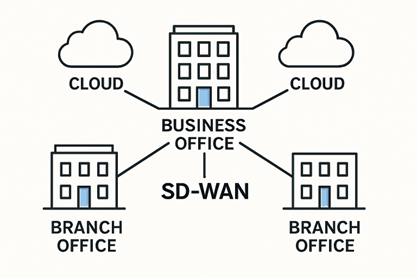
Cloud-delivered SD-WAN can be particularly beneficial for enterprises moving substantial workloads to SaaS or public cloud platforms, supporting direct internet access with consistent policies. Integrating SD-WAN with cloud-native security (often marketed as SASE, or Secure Access Service Edge) further consolidates networking and security management, streamlining operations and enhancing protection. Leading providers are often evaluated by reputable sources, such as Gartner’s reviews of SD-WAN vendors, giving organizations a starting point for solution selection.
Implementing SD-WAN: A Step-by-Step Guide
- Plan and Design: Create a blueprint for SD-WAN integration. Outline your desired network topology, set forth application performance metrics, and establish new security policies that address enterprise needs.
- Deploy in Phases: A phased approach reduces risk and facilitates feedback. Begin with a limited pilot rollout at selected locations to validate performance and gather user input. Quantitative metrics during this trial guide broader deployment and inform necessary tweaks.
- Monitor and Optimize: With deployment underway, businesses benefit most from active monitoring. Modern SD-WAN solutions offer deep analytics to spot congestion, application latency, and traffic anomalies. Continual performance tuning ensures optimal application delivery and adapts to changing network patterns.
Real-World Examples of SD-WAN Integration
Organizations across telecommunications, retail, and public sectors are achieving transformative results with SD-WAN deployments. For instance, a global telecom leader expanded its suite of managed network offerings by integrating SD-WAN technology through partnerships, delivering high-value solutions to clients across regions and industries. Another example can be seen at a major technology vendor that introduced a fully cloud-managed SD-WAN product designed for government agencies. As a result, these agencies accelerated their IT modernization goals, reinforced security, and improved connectivity for remote branches.
According to Cisco’s SD-WAN insights, many mid-sized and large enterprises cite significant improvements in application availability and visibility after SD-WAN integration, reducing the cost and complexity of branch deployments while ensuring compliance with regulatory requirements.
Overcoming Common Challenges in SD-WAN Deployment
While SD-WAN brings many advantages, it is not without hurdles such as legacy system compatibility and complex security requirements. To successfully navigate these, businesses should:
- Perform thorough interoperability testing with existing WAN hardware and software stacks to avoid service disruptions.
- Adopt a layered security approach, utilizing encryption, next-generation firewalls, and role-based access controls to counter evolving threats.
- Invest in ongoing IT training, equipping network management teams with the skills to optimize, troubleshoot, and secure a modern SD-WAN environment.
Additionally, partnering with a trusted managed service provider can help address resource constraints and accelerate successful outcomes for complex SD-WAN projects.
Future Trends in SD-WAN Technology
The SD-WAN landscape is rapidly maturing, with trends emerging around automation and integration with broader IT operations. Artificial Intelligence for IT Operations (AIOps) is making networks more self-healing and efficient by analyzing data traffic patterns and predicting failures before they disrupt business. The proliferation of SASE frameworks is revolutionizing security and access policies, consolidating networking and threat protection into single, dynamic platforms as remote work and cloud adoption continue to rise.
With these advancements, organizations can anticipate not only stronger network security but also enhanced performance visibility and flexibility as they expand operations globally. Staying informed on SD-WAN’s evolving capabilities positions enterprises to capitalize on next-generation networking and maintain a strong competitive edge.
Conclusion
Integrating SD-WAN into a business network represents a strategic leap forward in scalability, efficiency, and security. From the initial infrastructure assessment through solution selection, deployment, and ongoing optimization, a structured approach maximizes ROI and minimizes risk. The future of enterprise networking is clearly defined by adaptable, cloud-centric architectures, and SD-WAN stands at the forefront, ready to help organizations thrive in an increasingly digital world.
