

When organizations move past the early growth phase and continue to scale, HR and payroll are no longer merely administrative functions; they become operational pillars. After having 100, 300, or even 1,000 employees, the margin of error becomes extremely small. Payroll delays, compliance lapses, or inconsistent employee data can very quickly turn into financial risk and reputational damage.
Still, many mid-market and enterprise teams are sticking to a combination of legacy tools, spreadsheets, and standalone platforms. These workarounds may have been effective at the time, but they hardly ever reflect the evolving nature of the workforce. As a result, you end up with fragmented data, duplicate work, and limited insight.
At this point, HRMS software for businesses is instrumental. A combined payroll and HR management system enables organisations to bring together their workforce data, unify their processes, and comfortably expand their operations. Instead of juggling isolated workflows, executive teams get to the single source of truth.
Basically, a number of large firms are giving their utmost priority to HR and payroll automation, leveraging a powerful HRMS platform – not as a mere convenience but as a strategic necessity. WeekMate HRMS embraces this transformation with a scalable, cloud-first solution designed for structured growth and operational clarity.
The Hidden Cost of Managing Payroll and HR Across Multiple Tools
Broken HR systems cause hidden inefficiencies that accumulate and multiply over time. If payroll information is kept in one system, attendance records in another, and employee files are scattered across spreadsheets, mistakes are inevitable.
The most common results of fragmentation in HR systems are payroll errors. When manual reconciliations between time and attendance and payroll management software are required, the risk of incorrect payments, tax miscalculations, and salary delays increases. Companies operating across multiple locations and departments may face a higher risk.
Around 49% of businesses report payroll errors as a consequence of disconnected HR systems, according to Deloitte’s 2024 Global Payroll Benchmarking Survey. As a result, they have to redo work, face compliance risks, and employees get frustrated.
Moreover, HR departments lose their strategic edge. Instead of planning the workforce or working on talent initiatives, they spend time reviewing data and handling approvals. Typically, traditional HR operations management software lacks the level of integration required for large-scale operations and, therefore, is not a good fit for medium-sized and large enterprises.
In this situation, the legacy payroll management system is more of a problem than a solution.
What Is WeekMate HRMS?
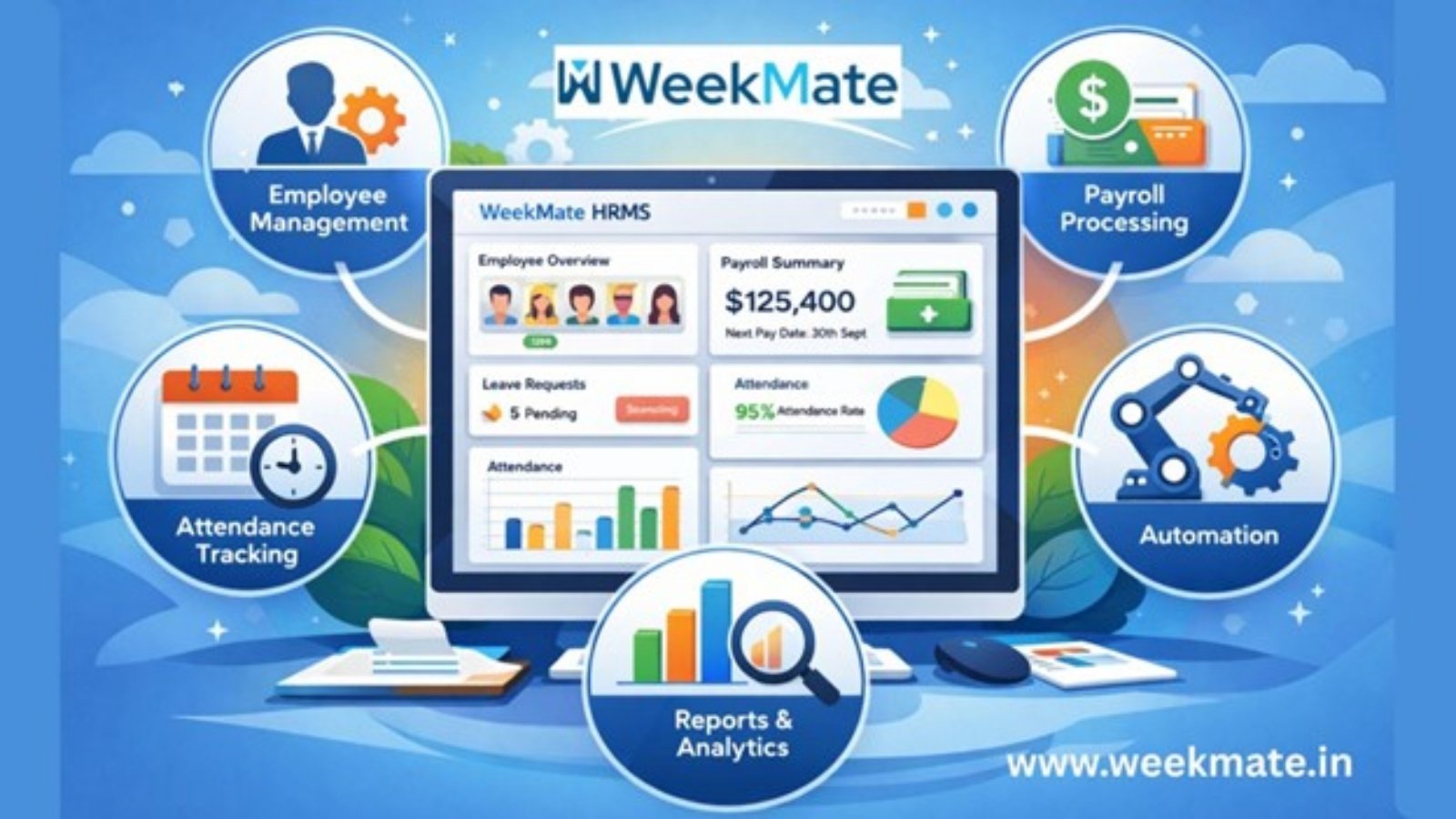
WeekMate is a comprehensive human resource management system designed to support mid-sized and growing companies in their day-to-day operations. It brings payroll, attendance, leave, and employee information together into a single, seamless system.
As a scalable HRMS platform, WeekMate reduces the risk of disconnected data by serving as the central source for all HR functions and payroll, enabling internal data reconciliation. Employee records remain consistent across all departments, payroll-related inputs flow automatically, and reports are standardized and audit-ready.
WeekMate is well-suited as HRMS software for growing businesses adopting more structured, compliance-oriented operations. It enables expansion without locking teams into strict enterprise frameworks, which typically slow adoption.
How WeekMate Streamlines Payroll through Intelligent Automation?
Payroll has to be accurate, period, especially at scale. WeekMates HRMS payroll software automates salary calculations, statutory deductions, reimbursements, and payslip generation, making the process extremely efficient.
Organisations that rely on automated payroll processing significantly reduce their reliance on manual verifications. Attendance, leave balances, and overtime are directly accounted for in payroll, ensuring accurate employee payroll management every cycle.
For finance and HR leaders exploring payroll automation for mid-size companies, this reliability translates into faster payroll runs and fewer escalations. According to a 2023 PwC HR Technology Survey, enterprises that implemented payroll automation reduced processing time by up to 35% while improving compliance outcomes.
With WeekMate, payroll becomes a controllable, expected process rather than a recurring risk.
One Dashboard to Handle All Your HR Needs
Beyond payroll, operational visibility is essential for enterprise HR teams.WeekMate is a workforce management software that centralises control over employee attendance, leave, performance tracking, and documentation.
Data security is ensured through role-based access, while employees and managers can self-service. By decentralising routine activities, such as submitting leave requests or accessing payslips. HR workload is reduced without compromising control.
For the leadership teams, the integrated dashboard shows the necessary information at a glance. In the case of HRMS software for businesses like WeekMate, workforce data becomes a means for planning rather than just record-keeping.
In summary:
| Feature Category | Key Capabilities & Benefits |
| Operational Visibility | Centralizes attendance, leave, performance tracking, and documentation. |
| Security & Access | Ensures data integrity via role-based access control. |
| Self-Service Tools | Enables employees/managers to handle leave requests and payslips independently. |
| Strategic Impact | Reduces HR workload and transforms raw data into actionable planning insights. |
| Leadership View | Provides an integrated dashboard for high-level, at-a-glance oversight. |
Cloud-Based HRMS for Modern, Distributed Teams
Mid-market and enterprise organisations operate across multiple locations and employ different work models. A secure, scalable cloud-based HRMS software will be the basis of remote, hybrid, and multi-location teams.
WeekMate keeps HR and payroll data available even when you are not in the office, so you don’t lose time on approval, updates, and reporting. Protocols for built-in security are designed to protect employees’ personal data, yet system updates are performed without users’ awareness.
The cloud-first design of this platform improves HR and payroll automation efficiency by eliminating infrastructure-related limitations, while enabling the business to grow quickly.
Why WeekMate HRMS Works Better for Growing and Mid-Market Companies?
To keep pace with the rapid growth of enterprises, the systems must be powerful and flexible. WeekMate is a strong option because it supports the organisation’s local policies through flexible configuration rather than forcing process changes.
Automation helps reduce operational costs, while faster onboarding and standardised HR workflows improve efficiency across departments. As HR operations management software, WeekMate supports compliance, reporting, and scalability without the complexity of enterprise-level systems.
For organisations evaluating the best HRMS for payroll and HR management, WeekMate delivers the balance mid-market teams need robust functionality without unnecessary overhead.
Business Impact: What Teams Stand to Gain from a Single HRMS Platform
Switching to an integrated payroll and HR management system yields tangible business results. Payroll cycles accelerate and become more precise, compliance reporting is more thorough, and leadership gains better workforce insights.
Employees learn about access and self-service processes firsthand, resulting in less transparency. Being a good human resource management system, WeekMate is instrumental in building trust and engagement, and in increasing operational consistency throughout the organisation.
Above all, HR moves from being a department of administration to becoming a department of strategy.
Summary: Single Platform Is Sufficient to Keep You in Control
As one thing after another, complexity increases as organisations grow, but that does not mean the level of organisation should be lower. A single HRMS platform maintains the required structure while payroll, personnel, and compliance are managed at scale.
WeekMate HRMS offers automation, visibility, and scalability in a single package. For mid-market and growing enterprises seeking dependable HRMS payroll software that evolves with their workforce, WeekMate provides a solid foundation for controlled, confident growth.
Frequently Asked Questions
Will switching to a new HRMS disrupt our existing payroll cycles?
A proper HRMS implementation should be more of a help than a hindrance. Solutions like WeekMate are purposely constructed to work with your existing payroll framework, policies, and practices, not to change them overnight. The teams will be able to complete the payroll transition in phases without interrupting the payroll process, provided they are supported by an appropriate setup. As a result, employees will receive correct, timely pay throughout the transition.
Is an HRMS only for very large enterprises?
No, not at all. HRMS tools are most beneficial when a company is transitioning from small to medium-sized. Once your team grows beyond manual processes but is too small to support complex enterprise systems, an HRMS designed for growing businesses will provide a framework, automation, and scalability capabilities without unnecessary overhead.
How does an HRMS improve compliance without adding more work for HR teams?
Rather than relying on manual checks and reminders, an HRMS automatically integrates compliance into daily routines. With automated payroll processing, standardized records, and audit-ready reports, there is less need for day-to-day checking. This enables HR teams to remain compliant while reducing time spent on repetitive administrative tasks.
What's the biggest day-to-day difference the teams notice after the adoption of a combined HRMS?
Transparency. Payroll runs become normal, employee data is always accurate, and approvals happen more quickly. HR teams regain time, employees gain transparency through self-service access, and leadership gains greater trust in workforce data. Adding features is less of a point; it's more about reducing friction in everyday operations.
